Hiring for industrial roles is not the same as hiring for corporate roles.
That sounds obvious until a company ...

Hiring for industrial roles is not the same as hiring for corporate roles.
That sounds obvious until a company tries to use the same process for both.
A controller search and a welder search are not the same problem. A VP of commercial development and a forklift operator do not require the same recruiting strategy. A one-off skilled trades role and a 300-person hiring ramp are not solved with the same playbook.
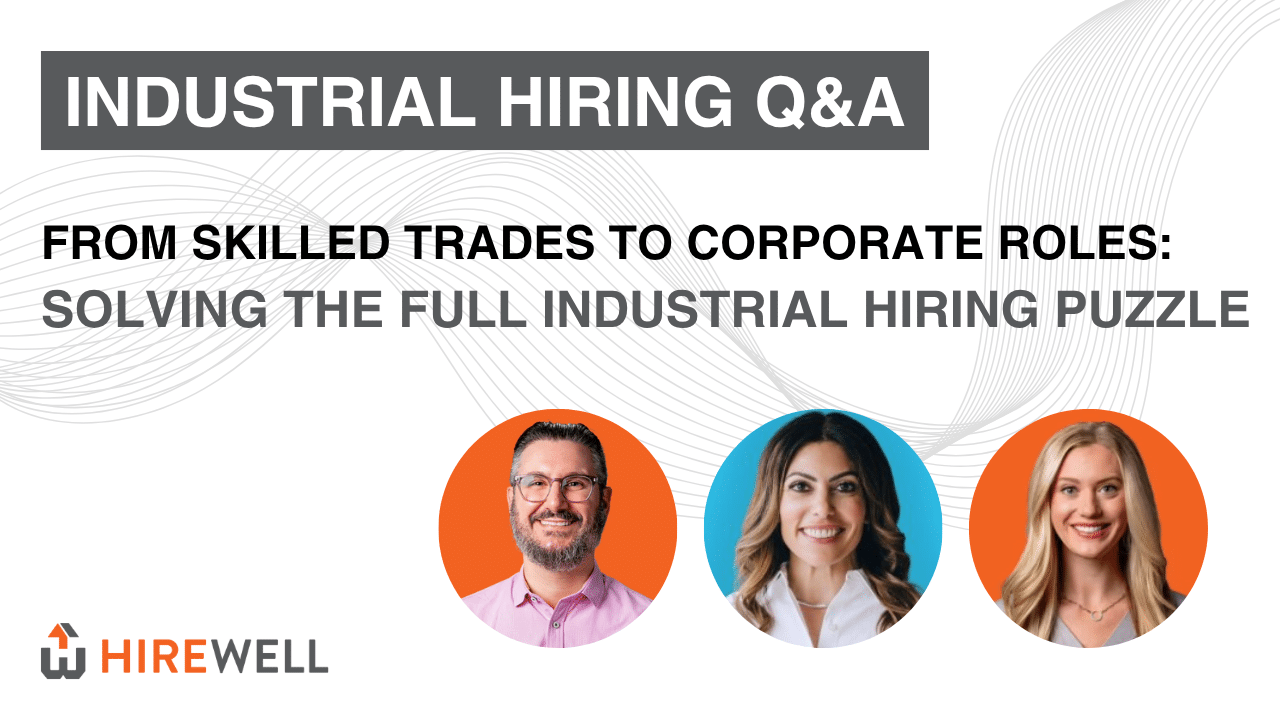
That was the center of a recent conversation between Charlie Saffro, Jeff Smith, and Shannon DiBenedetto. With CS Recruiting now part of Hirewell, the discussion focused on what companies actually need when hiring across supply chain, logistics, transportation, manufacturing, and frontline industrial roles.
The big takeaway: companies do not always need “more recruiters.”
They need the right recruiting capacity, the right process, and the right strategy for the specific workforce problem in front of them.
For years, many CS Recruiting clients have known the team for supply chain, logistics, and transportation search. That often meant direct hire, permanent placement roles, and partnerships with hiring managers, leaders, and executive teams.
But frontline hiring is the other half of the picture.
These are the roles that keep operations moving. Skilled trades. Production workers. Welders. Assemblers. Forklift operators. Yard workers. Drivers. Inventory specialists. Pickers and packers.
And these roles often sit directly underneath the same leaders CS Recruiting has partnered with for years.
That is where the Hirewell and CS Recruiting partnership becomes especially useful. It brings together deep industry knowledge with a broader recruiting engine that can support both corporate and frontline hiring needs.
One of the most common issues industrial companies face is not that their internal recruiting team is bad.
It is that the team was never built for sudden spikes in hiring volume.
Maybe there is a new product launch.
Maybe a new shift is being added.
Maybe a facility is scaling.
Maybe a company just landed a major customer and needs workers fast.
The internal team may be great at managing a steady flow of open roles. But when 25, 50, or 100 frontline hires are suddenly needed, the process breaks down.
Applications pile up.
Hiring managers get frustrated.
Candidates wait too long.
The best people take other offers.
That is when an external recruiting partner can step in as an extension of the internal team. Not to replace them. Not to bulldoze their process. But to add capacity, structure, sourcing, screening, coordination, and follow-through.
Industrial hiring leaders are also dealing with a strange new reality.
It has never been easier to get applications.
It has also never been harder to find the right people inside that pile.
One example from the conversation was a client who received 2,400 applications shortly after posting a role. On the surface, that sounds great. In reality, many of those applications were not close to the required skill set.
That is the problem with relying too heavily on inbound applications.
Volume does not equal quality.
For skilled trades and high-demand frontline roles, companies often need actual sourcing. They need recruiters who know how to find people, screen them properly, understand their work history, and uncover the story behind a resume.
A candidate may look job hoppy on paper because of plant closures, contract work, seasonal shifts, or temporary assignments. A good recruiter knows how to dig deeper before writing someone off.
In industrial hiring, candidate experience matters more than many companies realize.
A skilled trades candidate may be interviewing with multiple competitors. They may already be working long shifts. They may not be able to take a call in the middle of the day from the plant floor.
That means communication has to be clear.
Scheduling has to be flexible.
Preparation matters.
Follow-up matters.
A candidate should know who they are meeting, what to expect, what the company offers, and why the opportunity is worth considering.
This is especially important in smaller markets where word of mouth carries weight. If a plant has had leadership issues in the past, poor retention, or a bad reputation locally, recruiters need to help tell the current story. Maybe leadership has changed. Maybe retention bonuses were added. Maybe career paths are stronger now.
Those details rarely come through in a job posting.
They come through in real conversations.
Hiring events can be incredibly effective for industrial and manufacturing companies.
They can also be a complete waste of time.
The difference usually comes down to planning.
A successful hiring event is not just “set up a table and hope people show up.”
It needs marketing.
It needs scheduling.
It needs candidate communication.
It needs onsite logistics.
It needs interview flow.
It needs technical assessments.
It needs follow-up.
It needs offers, onboarding, and first-day details ready to go.
Without that structure, companies risk long lines, confused candidates, poor turnout, slow decisions, and missed hires.
With the right structure, hiring events can become a true conversion engine. The transcript included an example of 600 attendees, 297 offers, and three events over roughly 75 days.
That does not happen by accident.
Temp labor has its place.
There are absolutely times when it makes sense.
But when companies rely on temp labor as the default solution for every frontline hiring problem, it can create bigger issues.
Turnover stays high.
Workers do not see a career path.
Companies keep paying third-party markups.
Internal leaders struggle to build long-term teams.
And when promotion opportunities open up, there may be no internal bench ready to step in.
That is why direct hire strategy matters.
A frontline employee who sees a future with the company is more likely to stay, grow, refer others, and eventually move into leadership. Many leaders in transportation, logistics, and manufacturing started on the floor, behind the wheel, in the yard, or inside the facility.
Treating frontline hiring as transactional misses the bigger opportunity.
There is no single industrial hiring solution that works for every company.
Sometimes the answer is sourcing support.
Sometimes it is full-cycle recruiting.
Sometimes it is an embedded onsite recruiter.
Sometimes it is a hiring event.
Sometimes it is multi-site recruiting across several states.
Sometimes it is a direct hire strategy to reduce temp dependency.
Sometimes it starts with one role and expands into a broader workforce partnership.
That flexibility is the point.
Industrial hiring problems are rarely clean and simple. They involve operations, HR, talent acquisition, hiring managers, shift schedules, local markets, pay rates, candidate availability, onboarding, retention, and long-term workforce planning.
The solution should match the problem.
With CS Recruiting now part of Hirewell, clients get a broader set of recruiting solutions without losing the industry expertise they already trust.
For CS Recruiting clients, that means access to Hirewell’s wider recruiting capabilities across industrial, corporate, commercial, sales, technology, and other functions.
For Hirewell clients, that means deeper specialization in supply chain, logistics, transportation, manufacturing, and frontline industrial hiring.
It is not just about filling one role.
It is about helping companies solve the full hiring picture, from the corporate office to the front line.
Industrial hiring is not one size fits all.
The companies that win are the ones that understand the difference between a hiring need and a workforce problem.
A hiring need says, “We need people.”
A workforce problem asks:
What roles do we need?
Where is the process breaking?
What is slowing candidates down?
What is hurting retention?
Should we be using temp labor, direct hire, or both?
Do we need more recruiters, or a better recruiting model?
That is where the right partner makes the difference.
For more industrial hiring insights from Hirewell and CS Recruiting, visit:





Candidate Experience sucks right now. That’s it. That’s the show.
If you think back to 2021, when the job market was on fire, it was top of mind for everyone. Not just LinkedIn think pieces, but companies poured lots of time and effort into white-glove interview processes.
Now that the market cooled off, so did the effort. But there’s a disconnect: attracting talent isn’t any easier right now. In fact, it’s harder when you inadvertently cut corners.
Jeff Smith and James Hornick explain why ignoring candidate experience is costing companies big in The 10 Minute Talent Rant, Episode 111, “Candidate Experience Has Never Been Worse”
Episode 111