
Go-to-market teams are not simply getting bigger or smaller in 2026. They are being rebuilt.
Hirewell’s GTM practice has been our fastest growing division over the last twelve months. Across the searches our recruiters are working on, companies ...

Innovators in the recruiting space since 2001.
Our sister company. Helping people become better job seekers.
Visit Hirewell.com
Episode Highlights


Subscribe to the Talent Insights podcast on Apple Podcasts, Google Podcasts, (recommended for Android users), Amazon Music, or Spotify. Watch us on YouTube—and don’t forget to rate us!
In this episode of Stacked, Mark sits down with Phil Muldoon to talk about how Hirewell is helping private equity firms and their portfolio companies build more flexible, scalable hiring models.
They dig into why traditional one-off searches are not enough for PE-backed growth, how recruiting as a service creates consistency across portcos, and why specialized recruiting teams can improve both the hiring process and the candidate experience.
From standardized scorecards and ATS workflows to cost structure, delivery models, and long-term talent strategy, this episode breaks down what PE firms need from a modern recruiting partner.
Episode Transcript
[00:00:00] All right, welcome back to another episode of Stacked, where we talk about all things tech hiring. Really exciting episode today. What we’re gonna talk about is, our work with private equity and their portcos, and how we’re building some really great partnerships there.
I’ve got an awesome guest today, my colleague Phil Muldoon, coming out of Atlanta, and, he has been doing a ton in this space. He’s got some great, sort of case studies of how we’re structuring our relationships and some of the exciting things we’re doing here. So welcome, Phil. Thanks for having me, Mark.
Excited to talk about it. I think it’s, a real need in the market right now, and, excited to kind of dive into what we’re doing today. Yeah. Awesome. Excellent. So, I guess maybe where we can start before we dive into all the details is just, you know, how these partnerships have become so prominent for us and a little bit of the shift in the market and what you’ve seen there.
Yeah. So [00:01:00] I think talent acq- acquisition in general right now is looking for scalable, flexible models. And specifically with, some of our PE partners, they’re looking for standardized processes as they scale those models. And we can drive standardization really across a multitude of different portcos, and be the partner in driving that standardization while also giving scalability and flexibility.
So that’s, the broader talent acquisition market is going that way, scalable, flexible models. And then specifically for, you know, our PE partners, it’s about standardization of processes across a lot of their portcos. Absolutely. And I think, one of the changes, that I’d love you to comment on is I think a lot of times in the past, we just sort of came in through our relationships with portcos and not necessarily from the top with the private equity ownership, right?
And we’ve seen the desire, to actually start the [00:02:00] relationships on the private equity side of things and then sort of filter down into their portcos. I know that’s been some prominent relationships for you lately. You know, how did that come about for you? Yeah. I mean, I think in networking with a lot of private equity firms, you know, they were in search of solutions that were outside of your traditional single search model, and looking for a bit of a more comprehensive solution, that allowed them, to drive, like we said, that standardization across a lot of their portcos.
As opposed to bringing in a search partner for one portco, maybe running a single search for another portco, but that’s not enhancing, the talent acquisition process, right? And not leaving them with a reusable playbook. [00:03:00] And so what we’ve tried to do is be comprehensive in the talent acquisition solution, right?
So, helping them with ATS processes, right? Helping them build scorecards. Helping them drive out a process across the entire portfolio. And so that’s been really meaningful work for us, right? In not only just, you know, helping them find the right person for the role, but helping them drive the strategy, for talent acquisition, across the portfolio.
Gotcha. So how often are we kind of collaborating with internal talent acquisition versus, you know, us just sort of, running the whole thing? Yeah. I mean, I think it’s a 50/50 mix, right? At the end of the day, you know, the biggest success for the port or the PE firm and the portco [00:04:00] is to find the right hire.
but in that, we can drive process that Ensures that the right hire is found time and time again, right? So the short-term win is, you know, we hire the right director of software engineering, right? The long-term win is we build a repeatable talent acquisition process, that allows us to quickly, source and identify, the right group of people that they’re gonna hire in the next 12 to 24 months.
And so, you know, we’re helping both the short term and the long term, and that’s, I think, what a lot of our customers are coming to us for right now, is to the immediate wins, but also the long-term strategy. Sure. And I mean, the timing is, that’s the name of the game, right? When you’re, when you’re getting a high growth organization and our goal is always, like, get great talent in a [00:05:00] timely manner and have the experience be excellent both for our clients and for the candidates along the way.
For sure. So it definitely, it definitely fits well.
So, you know, when we talk about the actual delivery structure on our end, right, and how we model that, what have we put together to provide that timely delivery, that consistency, that kind of experience from a client and candidate standpoint?
Like, give us a little understanding of what that looks like. Yeah. So, the delivery model, and I’ve been referring it to more of recruiting as a service, right? You know, it is very scalable, in terms of, it’s low commitment, but if you use our services, you pay for them. And if you don’t, there’s a minimal commitment on your end.
But what it is it gives you, essentially, one throat to choke, across the engagement, right? There is one engagement [00:06:00] leader that is gonna be your, nonstop person, and then we are gonna build unique delivery teams that specialize in the skill sets that you’re recruiting for. We have a go-to-market team that’s gonna help with sales and marketing roles.
And then we’re gonna have a delivery lead, for go-to-market roles, and then they’re gonna have access to our whole team of go-to-market recruiters to drive that. We’re gonna have a technology lead or delivery lead, and they’re gonna have access to all of our recruiters in the technology side. We’ve got a corporate functions team, that’s gonna have access to the entire suite of, corporate functioning recruiters.
But there’s gonna be a delivery lead for that. So you’re gonna have a delivery lead, and an engagement lead that sits over top of that, that is driving standardizations, for those unique teams, and ensuring that you’re getting the exact same experience, whether you’re working with our [00:07:00] go-to-market team, whether you’re working with our corporate functions team, whether you’re working with our technology team, and also we have, obviously a manufacturing and logistics practice, as well as a real estate group.
Just a lot of the PE firms that we’re dealing with right now have been in that, that SaaS space. So really only engaging technology, corporate functions and go-to-market. Just to clarify for all of our listeners out there that might not know what we classify as corporate functions. So that’s our HR recruiting, our finance and accounting recruiting and operations, right? Yeah. So sort of all the corporate verticals, but we have the leaders with the specialty to kind of drive each of those. Exactly. Okay. It’s really important in recruiting that in order to find and identify the right candidates, you speak the language. You know, kind of the example that I always use if someone’s using the English language, right?
And they’re saying, “I play a sport. I play baseball, I play basketball, I play football.” [00:08:00] Those all make sense. The second you say, “I play wrestling, I play track, or I play swimming,” someone, you know, kind of identifies you don’t speak our language. And so our recruiters don’t say, “I play wrestling,” when they’re talking to an accountant.
They speak the accounting language, and that really allows us to identify the right folks, but also build a lot of credibility with the candidate that, you know, drives that hire. Gotcha. Gotcha. So you mentioned a little bit of kind of how we structure things and maybe some of the minimal commitment from, you know, these portcos and the PE partners.
You don’t need to go into a ton of detail, but from our cost structure, what are some of the ways that we’ve sort of put that together? Sure. So it’s usually a monthly engagement fee, that, you know, essentially secures that our team is gonna be ready. When you say jump, we’re gonna say how high, and that’s gonna give you access to the entire, you know, [00:09:00] 120-ish recruiters that Hirewell has.
And then from there, there’s gonna be a deeply discounted success fee. A lot of the industry works on 20 or 25 points, per hire. We’re able to drive, the per-hire fee getting down to 13 to 15% just how much you’re using the solution. And then, you know, when you think about it, if you just annualize the engagement fee, let’s say you signed up for one of our RPOs or recruiting as a service models, right?
And you didn’t use it at all for 12 months. That is still gonna cost less than having a full-time recruiter not recruiting anyone, right? And so it’s a minimal commitment, but it’s always there for you in case you need to hire. You know, there’s some of these, roles that we’ve run for five or six years where we’re completely owning, the [00:10:00] talent acquisition process, for a company.
And, you know, we’re always there. And so, if you didn’t use us, it’s probably gonna cost you 30 to 40 grand.That’s significantly less than a full-time recruiter. Sure. Sure. So you get the consistency of knowing that Hirewell is always there. Yeah. And if you really, you know, hit the volume of it, then you’re gonna see significant savings on the back end of that as well.
Totally. I think the biggest thing, and this kind of goes to PE but also really the consulting world, it gives you the ability to sell, against a talent pipeline that you don’t have yet. But you have the confidence that the talent pipeline can be spun up really quickly. I think that’s the biggest thing.
And yeah, you pay a little bit to do that, but that confidence, when you go out to market and you say, “Yeah, we can do this in front of your customers. [00:11:00] You don’t have the people to do it yet, but you know that we’re behind you, and we have this ultimate scalability, to deliver the talent that you need to really help your customers with whatever problem they need.”
Sure. I think what you just said is, I think, so topical when you think about high-growth portcos because usually the growth just isn’t like this. Like, it kind of goes in phases. You might have a really heavy six- to nine-month period or a year period, and then they need to get some people up to speed before they go through another high-growth period.
So having the ability to sort of, go pedal down and then take it back but not lose that consistency and that, that dynamic and relationship, I think is where we’ve seen our clients, really kind of lean into that relationship. Yeah. I mean, it’s, there’s nothing worse as a salesperson, than, you know, selling and not knowing you have the [00:12:00] capabilities to deliver, right?
And I think with engaging with us, you’re gonna know that you can sell, you can be building the plane as you fly it, and all of a sudden, you know, we sold X amount of seats on the plane and Hirewell’s gonna help us, fill those seats, right?
And so, I just think about it from my standpoint, a confident salesperson sells more, and so, you know, you’re gonna be arming your salespeople with the confidence that, yeah, we’re gonna be able to deliver this on the backside because Hirewell’s got our back and they’re gonna give us the workforce that we need in order to deliver this for our customers.
Confidence breeds success and success breeds confidence, right? And, it gives you the confidence to sell, because there is this massive, recruiting arm that’s behind you that’s gonna help you get the work done.
Right. Right. And I mean, we’re [00:13:00] delivering on a number of these simultaneously right now. Yeah. Yeah. So, you know, everyone on our team is very much, attuned to it and tied into, how to deliver effectively and what our clients are looking for and how we create that sort of consistent delivery feeling and experience.
So, as kind of a closing here, I would just say, if there’s anyone out there that wants to talk about how we’re doing this in more detail, and maybe talk through kinda what their plans are, what their struggles are right now, you know, let Phil and I know. We’re happy to catch up and discuss
in a little bit more detail. So, I’m mark@hirewell.com. Phil? Phil@hirewell.com. We keep it simple. Simple. Simple. Yeah. Any wisdom you want to impart still? No. I think it’s just, it’s exciting times because, industry’s changing a little bit right now and, I think, the flexible model has been working really well for us, for our customers, for us, for candidates. It’s giving this really unique candidate [00:14:00] experience that’s driving hires and, be excited to talk to anyone about how we can build flexible solutions that meet them where they need. Yeah, absolutely. And we got through, I think, our first episode of Stacked where the word AI was not thrown in there even once.
So, I’m not sure if that’s a good or a bad thing, but we did it, Phil, so. Congrats. Congrats. All right. Well, thanks. Cool. Thanks for joining another episode of Stacked. We’ll see you all next time. Thanks, Mark. Bye.
More from Talent Insights
Industrial hiring is a different animal. In this episode, Charlie Saffro, Jeff Smith, and Shannon DiBenedetto dig into what companies get wrong when...
AI is changing tech hiring, but the job titles are still catching up. AI engineer. AI agent engineer. Machine learning engineer. Data scientist....
Hiring demand is back. But the playbook changed. Companies still need talent. They just don’t want to overhire, lay people off, and do...
AI isn’t just changing how companies build. It’s changing who gets hired. We’re seeing a spike in fake candidates, AI-polished résumés, and hiring...
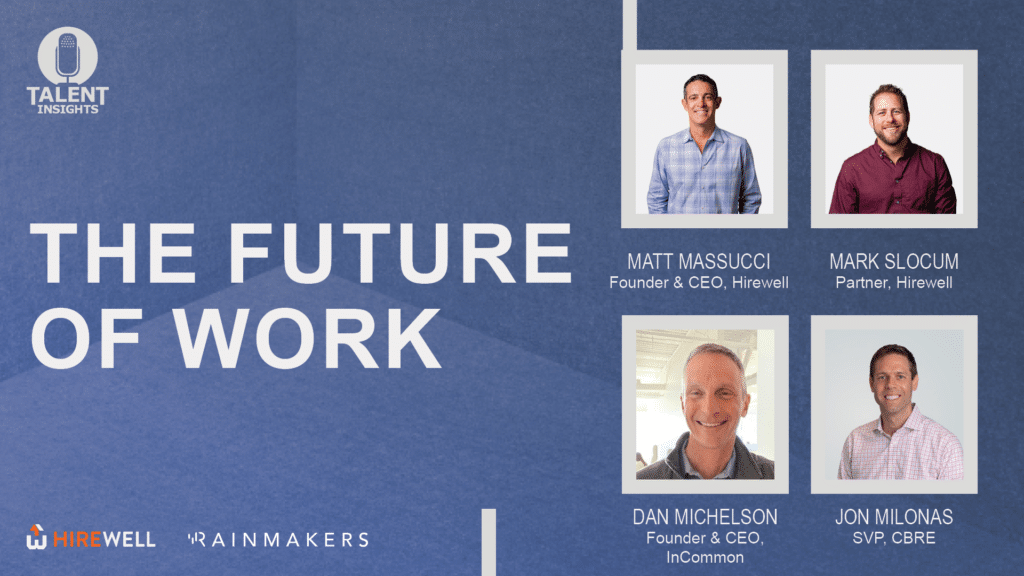
In this episode of Talent Insights, Hirewell CEO, Matt Massucci discusses “The Future of Work” with experts Jon Milonas, SVP at CBRE, Dan Michelson,...
New year. New hiring market. Hopefully. 2023 was a year a lot of recruiters are happy to turn the page on. But it...
Our Shows











Our Latest Blog
No results found.
More from Our Blog
No results found.