Hiring for industrial roles is not the same as hiring for corporate roles.
That sounds obvious until a company tries to use the same process for both.
A controller search and a welder search are not the same problem. A VP of commercial ...


Subscribe to the Talent Insights podcast on Apple Podcasts, Google Podcasts, (recommended for Android users), Amazon Music, or Spotify. Watch us on YouTube—and don’t forget to rate us!
Industrial hiring is a different animal.
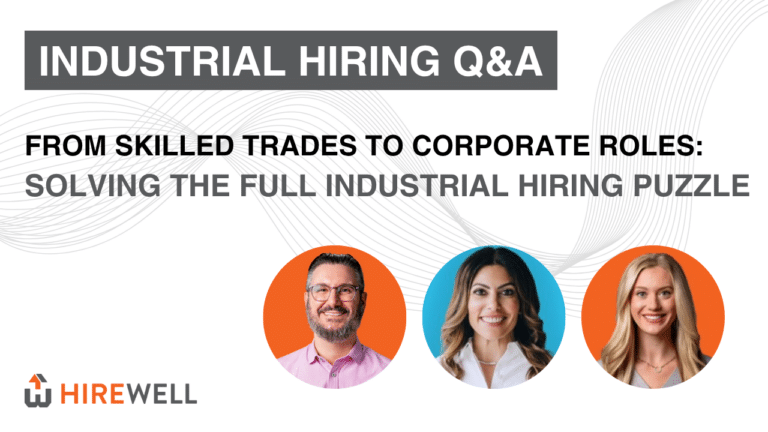
In this episode, Charlie Saffro, Jeff Smith, and Shannon DiBenedetto dig into what companies get wrong when hiring for frontline, skilled trades, manufacturing, logistics, and supply chain roles.
They cover why internal teams get overwhelmed, why job postings alone are not enough, how hiring events can either crush or completely miss, and why temp labor can quietly become a very expensive Band-Aid.
They also talk through what the CS Recruiting and Hirewell partnership now makes possible: deeper industrial expertise, broader recruiting support, and a more flexible way to solve workforce problems across the business.
[00:00:00] Most of our clients know us really as the supply chain logistics transportation experts, and historically we’ve worked on direct hire permanent placement roles, often working with leaders, with hiring managers, and executive teams.
And what I’m excited to talk about today is kind of the other half of that picture, and to really get into the frontline hiring, some of these industrial roles that often sit under the contacts that we’ve worked with for so many years. So we’re talking about, like, the high volume trading, the mass hiring, some of these skilled trades, which is really a completely different animal, and, I know you guys know this.
So rather than just kind of walking through how we can do this, I wanted to bring in my two colleagues, Jeff and Shannon, to really illustrate, like, some actual case studies and, talk about how we can help our clients as more of a one-stop shop now, and really be that solution provider for all of their supply chain logistics needs, whether it’s in the corporate [00:01:00] office or on the front line.
So Jeff and Shannon, excited to get into this and to walk through some actual case studies. Yeah. Thanks for having us. We’re super excited to talk through this stuff. We always feel like there’s all this opportunity to get in front of, especially in the manufacturing world. Like, you’re in those shops day to day, and, taking yourself out of producing something tangible and thinking about how you get from point A to point B,
is a topic that’s really near and dear to both Shannon and I. So I think to maybe frame this, before Shannon and I get into, like, how the sausage is made- what we’re trying to look at here is there’s two things that, for anybody who’s followed Charlie or followed us, the way you want to be considering these opportunities is twofold.
It’s how are you as an industrial hiring leader, thinking about solving for your [00:02:00] different workforce challenges. And making it even more compartmentalized and like there’s probably gonna be a different strategy to the things that you just referenced, Charlie, like the back office- Absolutely. Your controllers,
your bean counters, your commercial folks, and the welders, and the skilled labor that’s like building some of your equipment or your product. So those are two different workforce challenges that I think need to be considered in this. Yeah. And then the second piece is it feels 101 to us, but for folks who don’t hire every day, the concept that different hiring opportunities require different solutions,
is incredibly nuanced and incredibly important. And that’s where Shannon and I have really, over the last six to seven years, built a model that is differentiated, right? Right. So we’re gonna kinda walk through a few different case [00:03:00] studies. Is that okay with you, Charlie? Yeah. Yeah. I mean, I think what I have seen your team do, and I know that our clients will benefit from this, is those scenarios where, you know, clients know what they need.
They know what the end result looks like. They don’t always know how to get there. And, that is, you know, this partnership with Hirewell is all about identifying those pain points, but really coming in and providing solutions, not just a transactional hire, but a full scope solution. So I know that we have some great case studies to cover, and yeah, let’s jump into it and maybe, you know, start with, a case study and in a scenario where kinda going back to my point, like there was a client who knew what that end result looked like, but they came to Hirewell, and it was an opportunity to really think about step one, step two, and really taking them through the entire process as a solution.
So, Yeah, i’ll let you guys kick it off. I’m sure I’m gonna have a lot of questions along the way. Of course. So, I’ll try and make this quick. [00:04:00] But if we talk about differentiation and how we look at things, there’s a simple process in our backend, but a very powerful process, and it starts with what you just said.
Like, what’s the opportunity?
What is the end goal? The things that are known known to you as the customer or the company. So what operationally is happening? Then secondly, what isn’t working about the existing solution? So like where are the fail points? And a lot of the times that question is, unknown once we start talking about things.
We then diagnose the situation, then custom fit a solution, and develop an outcome. So we talk aboutin the back end of the project what changed, what worked for the best, and then what, you know, advice, what, catharsises do we have at the end that says like, “Oh, wow, the light bulb went on and we achieved this.”
So Shannon, I know you came prepared with, a couple of different, of these models that, [00:05:00] you know what, step four or five where we were like, “Okay, this is how we’re gonna custom fit this.” Let’s talk through the first, option that we’ve gone through. Yeah, absolutely. So one of the main issues that we see when we’re talking to clients is they have an internal recruiting team, but that team is not delivering the results that they need.
And that’s often coming, in the manufacturing space, obviously there’s business fluctuations. So their internal recruiting team is used to working on, you know, a set amount of open recs. And oftentimes they’re getting good inbound application flow, so they’re used to screening those candidates that have applied, getting them through the process.
But when there’s a huge hiring ramp-up, whether that’s, you know, just a new product coming out, a new shift line, a new schedule, whatever that may be, their internal team just does not have the bandwidth and the capacity to handle [00:06:00] that. I think you hit on- Yeah
something really important there, Shannon. Like, a lot of times these companies have the resources. Yes, there are scenarios where they come to us because they don’t have the resources and they need an external partner. But a lot of times they have the resources, they’re just not set up for this type of hiring, whether it’s the volume or the actual types of roles.
So, Correct
I know you’re gonna go there, but I think that’s something we see a lot, and just an important note. Yeah. Yeah, and another important note on that is the fact that with that internal team, we’re not looking to come over and take over their open recs.
We’re simply there acting as an extension of their team. So we want to work hand-in-hand with the internal recruiting team and then the internal HR team, and truly just act as that extension of the team. So when candidates are speaking to us, we want them to feel as if they’re speaking to an internal recruiter, because we’re selling the company the opportunity the exact same way that their internal recruiting team is there doing it as [00:07:00] well.
So what’s happening kind of operationally during these high fluctuation, recruiting and hiring periods is, you know, we’re facing the same issues, and these clients are all facing the same issues in this space, is skilled trade shortages.
You know, these are high demand skillsets and, yes, the internal teams oftentimes get good candidate inbound flow, but with the demand, there also needs to be that true headhunting.
We need additional recruiters who are, you know, spending their whole day sourcing and screening and doing that initial follow-up and follow-through, because there is a shortage. I will say, this is an interesting point to like, talk about AI. Yeah. Yeah. AI may solve this one day.
I’m not stupid to think that that might not be the case, but it is not today. Yeah. And so that, like, that brute force sourcing component is definitely a key- accelerator [00:08:00] to why this is a different type of way of looking at things. That’s a great point. I was talking to a client the other day who was in this type of scenario.
In our first conversation she said, “You know, the great thing about AI is we posted this role two days ago, and we already have 2,400 applications.” And then I checked in with her a few days later, and she’s like, “Well, those applications aren’t necessarily the quality or even have the skill set we’re looking for.
So let me go through them a little deeper, but I’ll probably be back in touch.” And I think that’s what you’re hitting on, Jeff. Like, the easy apply is actually making things a mess, and it’s overwhelming these internal teams when they’re spending their days sifting through bad applications. Absolutely.
Imagine 2,400 applications to find the diamonds. It’s nice to have inbound, but if the inbound is overwhelming, it’s actually incredibly counterproductive. Exactly. Absolutely. And that’s why we have dedicated recruiters who, again, really [00:09:00] understand the skill set that we’re looking for, and are not only just looking, hey, does this resume have the keywords and a match, but they’re also there also screening these candidates for culture fit.
We’re walking through and making sure that these candidates aren’t really job hoppy, or do they have the right skill set? But hey, maybe they look job hoppy on paper, but then we dive in deeper in further conversations of, hey, this plant closed. This was, temporary work. This was… we understand the story, which then, of course, helps with just the candidate experience too.
Because maybe that resume would’ve gotten passed up through AI because of the way, you know, their career path looked. But we’re screening and digging in deeper to provide that intel to the hiring team.
So with that as well, one thing that we have, worked closely with internal recruiting teams on is they often, of course, have a hiring process and interview process in place, but that’s [00:10:00] when hiring is a little bit more of a, streamlined process. But when there is a huge fluctuation of hiring needs, oftentimes that’s when you need to revamp your interview process and onboarding process, et cetera.
So we have been able to, you know, look in a consultive approach of, hey, here’s where the bottleneck’s happening, or let’s look at this process. How can we streamline this now in order to get to your end goal? Because your end goal of X amount of hires by the end of this quarter is not going to happen because you do need faster candidate movement.
So again, we work with them and their internal teams of, revamping that operational workflow as well. Not to mention, and this is kind of a comment and a question, but I’m going to assume a lot of your contacts that, you know, we are partnering with, they have a lot of other responsibilities.
Yeah. Finding the candidates, [00:11:00] reviewing the applications are one small piece of their role. They’re involved in all of the administrative work, the onboarding, the scheduling. So I think that’s another really important area where we can add so much value is let them do their job, and let us support by literally handing over a pipeline.
Correct. Yeah. Oftentimes it’s recruiting is such a small part of their day, but it needs to be a large part, and that’s where we’re coming in. 100% of our time is dedicated to the true sourcing, the phone interview process. And not only that, we also handle the coordination too. So, you know, often these candidates are currently actively working, and they can’t, they’re working on the plant floor.
They can’t just step out to take a phone interview- Right
or step out to go on site. That’s not a part of their day. So they need to do phone interviews maybe after hours or before [00:12:00] work hours of the typical 8:00 to 5:00. So, you know, that’s something that we also need to look at, is the availability.
And if, you know, an internal team member is busy throughout the day in, in meetings, internal meetings, strategy sessions, onboarding, those are all going to be taking up a large chunk of their day. So here at Hirewell, that’s truly what we’re there for, is solely dedicated to that true recruiting full cycle portion of the business there.
One of the things that resonates most when we talk to customers about this, regardless of how we actually structure the solution, because sometimes the opportunity is sourcing, sometimes it’s full cycle, sometimes there’s an embedded resource- Like, we think through the scope and say like, “Here. Here’s what we recommend.”
But everything hinges on the experience that the human beings involved are having. Yeah. And it’s not just the candidates. Like, the hiring managers matter, too. The executive team at the organization wants to [00:13:00] feel like they’re getting something out of this investment. Experience matters, and when there are these large influxes of recruiting opportunities, y- you want to add a shift, or y- you need 50x headcount Experience can wane with what you have, and things get missed, and then the candidate experience becomes a little bit more diluted.
We found that when we get these conversion rates that we get, which we’re very, very proud of, and retention rates, by the way- it really didn’t come down to anything other than every human being involved was bought in and running in the same direction, inclusive of the candidates. They felt like there was an investment in them.
In a world where skilled labor sometimes I think feels a little bit, you know, Passed over. Yeah … in that sort of process. Yeah. No, you make such an important point there, Jeff, and that’s something like I have talked about and [00:14:00] kind of obsessed over for so many years is like you can’t recruit if you can’t retain.
And so the retention piece with candidates, like that’s where it starts. It starts with the initial interview experience. Like, how was I treated? Was I looked at as a human being, or was I looked at as a number and a cog in the machine? But then even taking it a step beyond that, when you think of the support you can give these internal TA teams, these hiring managers, these HR teams, that’s part of a retention tactic as well.
So bringing in a partner, yes, to recruit, is also a very indirect retention strategy that, I think that’s just a great point to bring up, so often missed. Yeah. Yeah, absolutely. And it goes into, again, we’re going back to there are shortages within these skillsets. And so oftentimes these candidates are interviewing at multiple competitors.
And it goes back to, you know, how they feel the interview process is going, the communication. [00:15:00] Were they prepared for each step of the interview process? Did someone kind of walk them through what to expect, who they’re going to be meeting? Even, you know, the simple things of a preparation call prior to the interview of, “Hey, have you, you know, come up with some questions that you wanna ask?
Have you researched the company?” And oftentimes when researching the company too, these clients, these production plants are in, you know, smaller areas. And so there can be, kind of a status of that client. Maybe they have had bad leadership in the past, and now they have new leadership, but people have heard like, “Oh, I don’t wanna work there because I heard there’s a lot of turnover,” or, “Their leadership isn’t supportive.”
But they don’t know now that, hey, you know what? They have actually done huge strides to improve retention because of these changes, and let me educate you on that. [00:16:00] And again, you have to come in and really make sure that you are selling the opportunity, whether there’s, you know, retention bonuses now, whether there’s referral bonuses, what those new selling features are that aren’t always listed in a job posting, for example.
So I think the takeaways here, if you’re considering, something like this or just want advice is it, this all makes sense when you’ve got, to Shannon’s point, rec load spikes. Your recruiters are feeling overloaded, not because they’re not doing their job, but they they truly are overwhelmed.
It becomes more than what your workforce can handle. Maybe hiring managers aren’t seeing the type of quality candidate flow for a variety of reasons. Or your time to fill or retention rates are kind of fluctuating in a not positive direction. So like, I think everything is kind of summed up in sometimes,
companies don’t need more recruiters. That always [00:17:00] feels like the visceral, like, “Let’s just get somebody else to recruit a body.” It’s what they need is they need recruiting capacity and advising that direct everybody in the same direction so that again, back to the point of experience, everyone’s aimed at a goal.
That’s how I would look at it. Yeah, I think the advising piece is so important. Like, we are seeing so much more of the market and really understand what’s going on with the supply and demand of talent that, yeah, we’re gonna manage those expectations and really help them understand what’s feasible, and then go out and deliver it.
Right. So, another thing that we often see is when the workload spikes and they need a lot of hires quickly, is, we’ve partnered and run hiring events to help scale that hiring engine, if you will. So with that, you know, they have [00:18:00] an internal TA function, but again, we have to look at the hiring process and the interview process to scale very quickly.
So hiring events is a great way to do that because oftentimes the hiring process is, you do a phone interview, then maybe an on-site so you can do a plant tour then do some, you know, skilled testing while you’re there, then maybe a final follow-up interview after that. This is more of a one-stop shop where you can do, a couple days worth of on-site interviews.
So with that, something that Hirewell has really rolled out and done a great job with is helping build out the operational infrastructure behind a hiring event. Because a hiring event can either go very well or very wrong. And it really needs to be planned out thoroughly, in order for the process to run smoothly, again, for that
candidate experience. [00:19:00] Our inside running joke is that Shannon moonlights as an event planner. On the side, she’s coordinating it all. Yeah. True, but It’s part of the service offering. It is. It is. And so what I feel like most companies get wrong and why most hiring events fail is poor marketing.
If people don’t know it’s happening, you’re not gonna have a good show. Poor scheduling, if candidates don’t know when to come and then you have a huge onset of people all arriving, you know, if the hiring event starts at 10:00 and they all show up at 10:00, then you’re gonna have people waiting in line.
They have to go back to work. They’re gonna leave, and so you’re missing out on those opportunities.Poor candidate communication of what to expect, how, you know, what the hiring event is going to look and be and feel like. Then also just that slow follow-up too. People show up to the hiring event, they walk away and never hear back from the organization and company.
Right. That’s not gonna be a good [00:20:00] feel. and then from there, the lack of operational coordination from that point on. Who’s getting offers? When are these people going to be starting? When’s first day orientation? Are they in the applicant tracking system so that all of their information is ready to go for I-9s, offer letters, et cetera?
So all of those things need to be very well planned out and coordinated, or else it’s going to fail. Yeah. So with that, our approach, that has worked really well is not only an embedded recruiter, so again, people, bodies to help facilitate this event, so someone who’s actually on site helping, again, their internal team with the day-to-day But we also do branded hiring events.
So we are handling the advertising of these events on behalf of our clients. So, you know, we are making sure that in a variety of ways, whether it’s targeted social media [00:21:00] campaigning, whether it is radio ads, whether it’s flyers in kind of local areas, whether it’s partnering with local trade schools to make sure that they’re aware of these events, local colleges, you name it, we’re getting the word out there so that they know that we’re gonna get a good turnout.
And then we also are doing automated scheduling. So we’re making sure that if we have 300 people show interest in attending this event, we’re having them come at set periods of time so that, again, there’s not going to be a huge onset of people coming as soon as it starts, that long wait. Right. We’re making sure that we can make things move as, smoothly as possible.
But then with that too, even that, automated scheduling, we look to make sure, hey, is there like a waiting room area in case things do get bogged down so people aren’t just standing waiting outside? Can we have,coffee and donuts for [00:22:00] people waiting in, in the process as well? And then even in that waiting room too, what we’ve done to streamline process is, getting iPads out for the waiting room, so while people are waiting for their interview, they can go ahead and pre-register.
They can, you know, upload their resume, their personal contact information into the applicant tracking system, so again, that step’s already done and taken care of. So all of those things w- we are thinking step by step through. I have a question for you on that, Shannon. Yeah. I mean, when, some of these projects have been executed,
are these clients like have they tried to do that and not been successful, or are these, I’m going to assume many times these are new ideas that Hirewell is bringing. Like my guess is that they’re like, “Yeah, we’ve had this ad posted, you know, the job’s been on Indeed. We’re just not getting the volume.”
This is kind of going back to what we talked about in the beginning, like they know what they need to accomplish, but this is probably not something many of them are thinking of because [00:23:00] of everything you just mentioned. It’s a huge overwhelming lift to make it happen. Right. So I’m just curious, like have you seen both examples where they’ve tried and failed, or this is a new idea and that’s part of why they brought Hirewell on in the first place?
Yeah, I would say I’ve seen both. So maybe they have tried and it’s been, a low turnout and they felt like, “Oh, we put a lot of time and effort into trying to prepare for this, and it, there just wasn’t enough candidates to show up to convert to hires. Wasn’t worth our time.” Or they maybe have, you know, gone to job fairs in the local community, set up a booth, have some swag.
That’s also a great idea, but when you are really… That, that’s just more kind of branding and marketing, putting your name out there for sure. But when you are really trying to convert to hires and offers, this is truly an interview process. Like, we are giving the plant tour. We are also, you know, having [00:24:00] set workstations where one set station is even something as simple as a tape measuring test.
You would be surprised how many people are failing at that very first stage, and we put that at the very beginning. You know? So each stage gets a different kind of technical skill set, and then depending on where people go, from there, we then give them an intro to a hiring manager who we’re like, “Okay, you’ve done this.
Your background aligns more with welding. Here, we’re going to set you up with an interview right here, now, with our welding hiring manager.” And that’s where then the culture interview happens. Yeah. You know? So you’re meeting with the hiring manager. You’re meeting with HR. They’ve passed all these technical skill tests, but now it’s the cultural interview.
Finally, meeting with HR to get an offer extended, making sure all the information is uploaded in the system so that we can really then get the offer extended, scheduling [00:25:00] onboarding and first day details. Yeah. Can you guys, like, just to really paint this picture, can you walk us through a scenario and, you know, starting with maybe even, like, that first call with a client.
We have a new facility opening, or, you know, we just landed a huge customer and we need these seasonal hires. And what I think our clients are gonna really wanna understand is, like, what are some of these roles? What type of volume are we talking about? What type of turnaround from the first conversation to the day that these individuals are actually needed on site?
‘Cause so many of our contacts from CS Recruiting, they are the hiring managers. They are tasked with making this happen. They’re not always involved in the hiring. So I would love to just, you know, keeping it anonymous, but like really walking through some details of an actual project that we’ve successfully worked on.
Yeah, absolutely. You know, I think the main takeaway is that all of our [00:26:00] solutions are highly customizable and that’s truly where Jeff and I, during that initial conversation, is, “Hey, what’s the problem? What is your end result goal? Like, what are you looking to make happen?” Yep. And so, you know, whether that’s maybe they, again, have an internal team, but they need some additional support.
Or often what we’re seeing, is clients have relied on temp labor. And that is also, you know, a huge factor that we see is historically for hourly production hires, they’ve done, temp to hire or just temp labor. And that is where we see a lot of, clients come to us and say, like, “This is not working.
Like, we’re having an issue here. It’s just not making financial sense because the turnover is so high. it’s just unstable, and, you know, they’re paying an arm and a leg for temp support that may not show up.” [00:27:00] And so that is, something that we discuss with them of, you know, from there on, maybe you do need an on-site resource.
Is there someone who you need additional support to actually be there to conduct these on-site interviews and help with the offer and onboarding and work directly with the team? Or is it something that, you know, a team of remote recruiters, you’re just looking for more volume, so the sourcing and the screening, and then your team internally can handle the interview process from there on.
that’s also something.If you’re looking for more of a team of dedicated recruiters versus, you know, an on-site resource, of course, with the backing of Jeff and myself and team, for operational support, again, really it, it’s very customizable in that way, shape, or form. and then also, again, looking at operations, looking at events, looking at, also tools is another very important thing.
Often internal recruiting teams rely on [00:28:00] internal postings. Mm-hmm. They don’t have access to all of the different sourcing tools, that Hirewell has. So that’s also a huge resource, and that’s what’s coming, as well with our fees is the tools and, job boards, but advertising, marketing, all of that is coming behind, not only just the recruiting.
We find, That customization works so well in scenarios where if we wanna talk data for a second. Shannon referenced a bit ago this idea of we’re adding a shift. Perfect example. You know, where this is gonna add 25 to 30 headcount.
That I could say pretty confidently with Shannon that that’s probably a three-month engagement.
We can commercialize it effectively. We can get those seats filled with the, objective being, yeah, okay, we’ve got worker- we’ve got those shifts filled. We’ve socialized with candidates that [00:29:00] can handle backfill, ’cause we know that there will be attrition. It’s just we want that attrition to be as minimal as possible
which is all connected to experience. That’s how I would look at something short-term like that. Like, we can solve for an acute problem and use the same processes that we would use for a 600 attendee, hiring event where we’re, you know, by the numbers, if we, our last one was 600 attendees, 297 offers extended across three events over a, I think it was a 75-day period.
That was the program we put together. That’s the customization. And those are like, I think, that’s the raw data points that t- what you were talking about, your customers are really gonna say, “All right. I see the value add.” And not only that, let’s say you come to us and say, “Gosh, 50% of our onboards are falling off,” and we write in [00:30:00] a KPI that says, well, we’re committing to 25.
Right. That’s a significant move- Right
and we can run towards that as a collaborative goal. And Shannon, you brought up, I know that you buried the lede there, which is great, but I think our last talking point really then does start to kind of form around all y’all, you know, maybe this resonates with some CS customers, but, like, temp labor is a thing.
You probably see it most in the driver market, right, Charlie? We see it a lot with, both skilled and unskilled labor, like- Do we all kind of agree that sometimes it’s a bit madness? Like, when does it stop making sense? Exactly. Exactly. It’s a different type of recruiting. I mean, it really is.
it’s a whole different ballgame. And I think the customization that Hirewell offers is underrated and incredibly unique. There are so many firms out there that it’s, you know, “This is our solution. You come to us, we execute it, we do it again for [00:31:00] the next customer, and again for the next customer.” And, um, that’s where we can get creative and really dig in and, like, what are the pain points?
What is the objective? There are so many different ways, I mean, that we’ve already talked about that we can go about it. So I just, I applaud the creativity and you guys looking at what the end goal is, and then kind of backing out of that to figure out, again, using the data, but how we’re gonna get there Right.
And often, you know, temp labor can just be a Band-Aid on the bigger issue. You know, the bigger workforce problem isn’t always just hiring volume, it’s the workforce structure. Mm-hmm. And so again, that’s where Hirewell comes in, and our approach is a little different. So again, very flexible RPO support.We can also really specialize in multi-site recruiting. So that’s something, you know, important to notate as well. Oftentimes when I’m talking to a client, they may have only worked [00:32:00] with agencies that are local to their area. And they realize like, “Oh, Shannon, you’re in Chicago. Aren’t you only doing recruiting in Chicago?” No, no, no, no. We are nationwide and have experience working in every state and in so many different markets.
And you know, I’ve done a lot of supporting of clients who, we start off in one facility, and they’re like, “Okay, wait, we need help in this facility, in this state, in this state, in this state.” And you know, and we really expand our partnership that way. So you know, I think that’s really important to know is we’re not local to one market, we’re nationwide and can support multi-site recruiting.
Again, we’re looking at job market optimization. we’re looking at what is going on with their direct hire strategy. What are the selling points, you know, that we can sell to candidates, whether it’s that career growth, because that’s another thing that we are seeing when, you’re relying on temp labor [00:33:00] is there’s no path forward.
There’s no path for advancement, so why would these candidates want to stick around? If they’re gonna get an offer even for a dollar, $2 an hour more somewhere else, they’re gonna jump ship.
But you know, if you have a direct hire strategy where, you know, you’re starting someone maybe at this pay rate, but you educate them of, hey, like, this is the path forward in your career here, you know?
If you do X, Y, and Z, this is the possible outcome that you could have of promotion. And oftentimes when they come to us for, you know, one-off hiring of, maybe a mid-level manager, they’re like, “We can’t find anyone, and we have no one to promote from within because we’ve relied on temp agencies for that support.”
So it’s not only just a Band-Aid of, looking at, hey, we need hourly workers right now. You need to look at it even from a broader perspective of the path forward of advancement [00:34:00] from within of your organization too. Yeah, and I know Jeff, you brought up drivers. I mean, that is, you know, one very glaring area in our industry that is always looking for volume talent.
But in addition to that, I mean, we are working with so many asset-based transportation providers. So we’re talking about, you know, in the yard, the yard workers, the unloaders, the pickers and packers, the inventory managers, when we get into even, like, 3PL warehousing within the four walls of a distribution facility.
And then I know an area where you guys are really experts is these manufacturing environments, which could be, you know, raw materials, finished goods, and all the different hands and brains that have to go into what we talked about in the beginning, like taking something and really getting it processed so it comes in one door and goes out the other, but there’s a lot of parties involved.
So, can you share any, like, examples of when you go to these [00:35:00] hiring events, is it usually for one role, or like what I’m talking about, a variety of roles, a variety of shifts? I’m gonna guess your answer is it’s always different, it’s always customized, but, I’m just curious to kind of plant those seeds in
our listeners’ minds of like, “Oh, wait, we have that need,” or, “We’re anticipating having that type of need as we grow or, you know, towards the end of the year.” Yeah. No, absolutely. I would say it really varies, and we typically are hiring for a variety of roles most of the time. Right. So, that can be, again, welders, forklift operators, assembly workers, painters,
winders. Truly you name it within that space, we, we have done the hiring for. So- And you speak the language. And I think that’s such an important point too, the clients don’t have to start from the beginning with, “This is what we do. These are the roles we hire. This is what the role responsibilities are.”
Like, we speak that language already. Huge advantage. Absolutely. Yeah, and again, just that high volume is [00:36:00] something that we, have done a lot of work with. So, a client working in multi-states, we, did over, you know, I would say on average, we were doing 12 to 15 hires per week per facility,
which resulting over, you know, 1,000 offers, as well across those locations. So that’s something, you know, maybe if you’ve worked with Hirewell or CS in the past, you don’t think of high-volume hiring, but that is something that we have a whole team dedicated to. It’s pretty high volume. It’s cool because, like Shannon said, a lot of it starts, it’s not a beta test, but it’s a smaller proof of concept.
Right? Like, we wanna make sure we’re invested in making sure that the solution is right fit, right time, right place. And then we can scale it internally. So I think that’s like an additional sell. Like, certainly we know how to scale it from a process perspective and taking our methodology and just kind of white labeling it here, here, here.
[00:37:00] But even internally across plants, we can look under the hood and say like, “Oh, okay. Like, this is what needs to change for our process in Riverside versus Lafayette versus Fairburn,” wherever these plants are. Acquiring.
Yeah, right? and ensuring that we’re taking the best components of what the customer does and not touching it, and then ramping up and really accentuating the stuff where there’s opportunity, and plugging those holes with what we know to be best practice.
Like we kind of started to talk a bit about, when temp labor stops making sense. And there’s so many financial components involved. Again, if I’m speaking direct to an audience that’s a buyer of this.
You do have to consider, like, your insurance liability and such if you’re gonna onboard folks full-time.
We understand that, us three. I don’t think a lot of recruiters do think through that [00:38:00] liability.
But to Shannon’s point, if the solution is constantly just keeping labor at an arm’s length in a temporary capacity, you’re not investing, right,in their career. It’s kind of what you’re signaling at least.
I just, this is like a psychology lesson. I’m not saying that that’s not, that’s the intent, but it’s probably how it’s received by some of the candidate population. For sure. And secondly, the money that you could use to invest in that individual specifically is literally going to a third-party company.
Which again,
there’s use cases for that. I’m not saying that you can just get away with moving to a direct hire component. Rather, developing a program around converting that talent to direct hire at some point has proven to be wildly successful. Again, just a couple of like interesting, unique micro, examples of things that we’ve [00:39:00] actually done.
Yeah. I mean, that’s a great point too, because when you’re working, I’m gonna guess nine times out of 10 there, there’s a growth opportunity, which is why we are being brought in a mass growth opportunity, and hopefully it has momentum and it has legs and it continues on. So you’re not just looking to hire a one and done, come in, do the job, leave tomorrow.
These could be long-term employees, loyal employees who have their own networks, who bring in their own referrals. But, yeah, hopefully the company doesn’t stop scaling and they’re able to move vertically within, which is a very big selling point. It’s these small communities, ideas, like word of mouth matters,
in those communities. Oh, yeah. This is not news to people who are recruiting in this space, and experience is so key. Once you get somebody having a positive outlook on their career and their work, and they’re feeling super fulfilled about going in and creating something [00:40:00] tangible in a lot of these use cases, that becomes exciting for the community, and candidates with those sorts of skills are drawn to want to work there.
I can’t tell you how many of the contacts in my network that are executive leaders started on the ground floor. They started behind the wheel. They started, you know, unloading or in a facility as an assembler, and, got their hands dirty and are still with, that same company or were able to move on within the industry.
But, understanding that level of work and again, what needs to happen to make the sausage, that’s a whole other, a whole other story. We’ll have a whole other conversation about that. But, yeah, I mean, so many of these leaders started there, so don’t just assume this is a transactional hire.
Yeah.
Yeah, I think, next on that point is I feel like oftentimes our recruiting partnerships evolve as the company scales. So with that, often we are engaged [00:41:00] for a single role, but then we often expand into a broader strategic partnership. So this has happened more often than not, honestly.
But what has happened is we are working on one role, and then a client starts getting more requisitions. We are able to then discuss expanding the engagement. We discuss that custom pricing structure as well as just how we can evolve the partnership. Because as we know, recruiting needs ebb and flow, and so I think that’s really important is that Hirewell is able to pivot quickly and deliver results. So that’s where Jeff and I really, come in with different approaches. So we offer different fee structures, different pricing by role type. Then we also can bring in other practice areas. You know, I think it’s important to note that yes, right now we’re kind of focusing more on this discussion around [00:42:00] industrial hiring and supply chain hiring, but we also here have, Hirewell dedicated teams that are able to support sales and technical hiring, as well as commercial and corporate function hiring.
So we have that one-stop solution for you when it comes to your hiring needs. So that’s where we see a lot of our partnerships scaling. I think, Charlie, one of the things that is your customers come to you for your industry alignment, right? And you’re kinda servicing across that gamut. We look at it’s not, better or worse, it’s just a different way of looking at it in that it, like Shannon had said, that skills, alignment.
And so, we’ll engage a client. For instance, we have a client, They produce large electrical equipment. It started with a single kind of profile rec [00:43:00] for a skilled labor role. They were direct hire, so it was a little bit more of a plug-and-play sort of solution, tangible model.
There were candidates for it. But there, you know, when we sell, “Hey, we’re the one-stop shop,” it’s like, “Okay. Well, let’s see what you can do,” right? And we show them what we can do, and that expansion kind of happens naturally. “Hey, yeah, actually we do. We need a VP of commercial development.
We need a scheduler, you know, in the logistics world. We need materials handlers. We need packagers. We need a controller.” That’s where I think our firepower really starts to make sense. And then, like, once we have that proof of concept and we’ve developed a relationship with the customer, a lot of it makes that conversation a little bit more organic.
Yeah, and those are the conversations our team, that we’re having today with our clients. I mean, they’re using multiple vendors. They have these needs. We left a lot of opportunity on the table in these previous years [00:44:00] where, many times we referred them to Hirewell or, you know, a partner that we knew could deliver for them.
And, I think that’s very appealing, especially to our contacts in procurement, or even, you know, talent acquisition and HR. Like, wait, now we already know you. You know us. You understand our culture. You understand the type of profile we’re attracted to, and, you know, the growth opportunities. So you’re telling us now you can do it all for us, and, I think that’s something that a lot of our clients are excited about, just to think of having this, you know, even longer-term relationship and expanding that relationship.
And I know we’ve pulled in so many, you know, new colleagues from Hirewell for those conversations, but obviously that’s the strategic piece of all of this.