

Everyone says they use AI now.
But there is a big difference between using AI and actually knowing how to apply it to your job.
For go-to-market hiring, simply having ChatGPT, Claude, or another AI tool in your workflow tells an employer ...

Innovators in the recruiting space since 2001.
Our sister company. Helping people become better job seekers.
Visit Hirewell.com
Episode Highlights


Subscribe to the Talent Insights podcast on Apple Podcasts, Google Podcasts, (recommended for Android users), Amazon Music, or Spotify. Watch us on YouTube—and don’t forget to rate us!
AI is changing tech hiring, but the job titles are still catching up.
AI engineer. AI agent engineer. Machine learning engineer. Data scientist. Forward deployed engineer.
Some of these roles are new. Some are old roles with new tools. And some get used interchangeably even when they should not.
In this episode of Stacked: Tech Hiring Insights, Matt Mulcahy breaks down what these AI and engineering roles actually mean, how companies are hiring for them, and where the market is headed.
Episode Transcript
[00:00:00] All right, we are back with another episode of Stacked: Tech Hiring Insights by Hirewell. Super excited about this episode. I’ve got a great guest, Matt Mulcahy one of the leaders here at Hirewell and one of our AI experts. What we’re gonna talk about today is the AI engineering landscape.
Matt is gonna help by starting with some baseline definitions to help us kinda understand what it is we’re even talking about, from just kinda the ground up. And then from there, we’re gonna dive into how we’re seeing the market shift, what are some of the trends, where we see things going. And then obviously talk a little bit about kinda firsthand what Hirewell is doing with our clients and how we might be of assistance, for anyone else looking for a little help on how to best go about hiring in, in this new AI world.
So, welcome, Matt. How you doing? Yeah. Great. Excited to be here. Thanks for inviting me on the show. Absolutely. Absolutely. Well, awesome. As I said, I’m gonna hand over the mic here, and I’m gonna let you take us through, the [00:01:00] basic sorta idiot’s guide to AI engineering and everything, inside of that.
So let’s do it. Yeah. Yeah. It’s a whole new world in technology with AI and how fast it’s, moving and changing, and we’ve got roles that didn’t exist three years ago. So I’ll try to break it down in as layman’s terms as I can. So, I think that the big one that everyone’s talking about is just the title AI engineer or even AI agent engineer.
I’m sure you’ve probably seen plenty of those roles popping up everywhere and I think, some people don’t even know what that truly means. That’s where you come in, Matt. Yeah. Advise us here. Yeah. Yeah. So, sometimes those two titles, AI engineer and AI agent engineer, are used in-interchangeably, but, there, there really is a distinction.
And the way that I think it’s easiest to define those two [00:02:00] things is an AI engineer is actually developing and training a model or large language model, LLM. There’s gonna be a lot of AI jargon that we’ll get to, but these, these terms are pretty common so far. and then AI agent engineers are developing agents or agentic workflows, which are really the systems and tools that execute tasks and actually do something or provide an output.
So an example of a popular AI agent now is OpenClaw, our Anthropic’s AI agent that came out a couple months ago. Gotcha. Yeah. So how does that, AI or AI agent engineers compare to, what we hear with machine learning engineers? Sure. Sure. I mean, I think a lot of machine learning engineers have evolved into [00:03:00] AI or AI agent engineers.
And you know, that was the more popular term before generative AI or gen AI’s widespread use and, just kind of common knowledge with the launch of ChatGPT in late 2022, early 2023. And machine learning engineer roles still exist, and they’re still focused on developing models to analyze and interpret data and make predictions or actually make decisions without having to explicitly programevery single thing.
I think now if you see a distinction between machine learning engineer and AI engineer, machine learning engineers will still be focused on model development and sometimes developing those models from scratch.
Whereas today, there’s a bunch of off-the-shelf models from companies like OpenAI and [00:04:00] Anthropic and Google and Meta that you can use to customize for your business’ specific use case that they wanna build an AI agent for. Gotcha. Okay. now we’ve all heard of, you know, data scientists for many years.
Like- Yeah … do they still exist? Where do they fit into this ecosystem then? Sure. Yeah, and I think data scientists can still be kind of the umbrella term for machine learning engineers AI engineers, data engineering, data architects, And data science, I think traditionally used machine learning as a tool, and now are using generative AI as a tool to perform those complex analyses.
And I think also in general, data science has always had a little bit of a wider scope of technical skills than maybe your traditional data analyst that is associated with more junior level [00:05:00] talent. So data science, they have deep knowledge in system design, software development, they’re writing code in Python and R and SQL, and those are just the most popular languages, but there’s certainly more that you can use.
But we don’t wanna go down so many rabbit holes here with, all the technical terms. Sure. So, then within all of this, there’s still kind of data engineers, data architects as well, right? Yep. Yep. And yeah, I think what’s changing about data engineers and data architects, and even data analysts, is the tools that they’re using, you know?
Their tech stack is changing and the tech also has built-in AI features and functionality that they’re taking advantage of. So, they’re not always having to build every query or ETL pipeline from scratch. They can use AI to build it more rapidly and
you know, spin [00:06:00] up, data warehouses quicker and build the data architecture that they need with less resources and also less people in some cases. Sure. And I know we’re seeing it at Hirewell and many companies, like what you realize pretty quickly when you’re trying to do anything with AI is if you don’t have a good database to start from, right? Like clean data in, clean data out, you know. If you’re building models upon data that, that isn’t good, then you’re just gonna get garbage out, right? Sure. Sure. And yeah, I think that kinda comes back to the AI agent engineer that’s emerged where, like there are these off-the-shelf large language models, but if you just do a GPT, API call for your chatbots on your website without providing any more context to what that chatbot needs to do for customers, then, you might be seeing memes on the internet [00:07:00] of, people using your chatbot to generate a Python script instead of, asking about the status of their order, right?
So I think that’s also something that’s changed as well, where, you know, you can take those models and use things like RAG pipelines to provide more context and, actually train a model on your internal knowledge base or your FAQ section on your website to, really give specific outputs that are only relevant to what you want users to do with it.
Gotcha. All right. Well, before we lose everyone, going down the dictionary, the last role that I want to talk about that people might have heard of, that really is more client-centric is the forward deployed engineers, right? Yep. Yep. And I still think that’s probably the newest of all of these and, coined by the company Palantir.
And really it still [00:08:00] is traditional software engineering, software development, but the expectations of those software engineers and developers have changed and they’re now taking on responsibilities that more traditionally were held by a business analyst or a product manager. So these developers are now client facing, working with customers, gathering requirements, scoping out work, writing user stories and other documentation, and then actually writing and deploying the code as well.
So, yeah, there’s just much higher expectations for these forward deployed engineers. Yeah. So, you’ve said it a few different times, you know, all this is basically new within the last couple of years, right? Yep. So there aren’t many experts, they probably work at, Anthropic and things, right?
Like, but- Right. So how do organizations hire for this [00:09:00] skill set? Tell us a little bit about what you’ve been seeing and, maybe some case studies of clients that you’ve been really involved with, to kind of help them scale this function out. Sure. And I think in many cases, companies are figuring it out, right?
You know, sometimes they know they need AI, they know their software product, they want AI features and functionality, but they’re not super sure on how to implement those, how to build those, the talent that they need. So, I mean, oftentimes they’re hiring experts, they’re hiring early adopters, people that have experimented with AI, maybe not in their full-time job, but on the side on projects that they’re passionate about, and they wanna learn about these new tools and, they can get the opportunity to really do that work at a real-life company these days.
[00:10:00] Yeah, I feel like we’ve seen three different needs when it comes to kind of the, AI hiring right now. There’s sort of the process, like internal corporate process, AI automation, that doesn’t necessarily need to be an overly technical individual, right? Yeah. Like, I mean, it could be somebody that has that background.
It could be more, of an operations-focused chief of staff, COO, things along those lines, project management type background
Sure
that’s thinking about how to go through everything and then, you know, utilize AI to help make things easier and automated, right? Yeah. So there’s like that bucket.
Then on the more technical side of things, I think there’s sort of two things that go somewhat hand in hand. There’s the engineering process, right? And how you build AI tools into your engineering process to be more efficient, to automate more, and, you know, just get a higher output from less people.
That’s the name of the game in hiring
Sure
[00:11:00] engineering. That’s why we’ve just seen the senior market still very active and the junior to mid sort of get crushed? ‘Cause they want their best people getting better by utilizing these tools. And then there’s the output of that, which is truly building AI-driven products for external clients and customers, right?
Yeah. And so I think those are kind of the three main ones that we’ve really seen or, obviously helped our clients with. But there’s so much more than that and you’ve been able to kinda help drive a lot of our RPOs and major projects where, you know, those are six, 12-month-plus type of engagements where it’s not just hiring, but it’s the change management and the process that goes along with that.
And I know you have one or two really good, you know, scenarios over the last kinda six to 12 months. So talk a little bit about like what that journey has been. Yeah. And broadly, I think we’re seeing clients that had a traditional data science department, and then [00:12:00] now that’s evolving into different designations within AI and AI engineering and AI agent engineering and AI platform that’s focused on the infrastructure required to have these, AI features and functionality.
So it’s definitely an evolving landscape. And we’re seeing high-growth orgs really invest in AI. And I think the common denominator, especially with those three buckets that you mentioned, is all of those individuals within organizations are using AI tools to do their jobs faster, more efficient bigger outputs and kind of comes back to that term that I’m sure people have seen, like the 10X developer.
I think it’s gonna extend past that. Everyone needs to 10X their productivity with the use of AI.
Yeah. Well, it’s certainly been an [00:13:00] interesting last few years. Having been doing this for 20 years and starting to work on roles that didn’t exist, you know, just a few years ago is kind of a, a fun time.
Could be scary if you look at it that way. I think it’s exciting, obviously, heading into a new wave of things. But, you know, if you look at just the last kinda year and a half, 2025, 2026, our team has done, roughly 400-plus placements. Over half of those were kind of in the engineering sphere, and already, about a quarter of those, are sort of AI-centric roles.
With another 10, 15% on kind of more the AI product, management for deployed engineers, right? Yeah. And then the rest kind of traditional engineering roles that all are sort of in that, like, AI-enabled engineering at this point and kind of moving to more of the norm. So, I think that’s just gonna continue, to be the normal, right?
Yep. To the point where it just becomes engineering again and, you know, it just is what it is. There isn’t, like, almost the AI is just, a given, right? Yeah. Yeah. So- I mean, we’ve [00:14:00] pretty much seen every client that we work with that’s hiring technologists asking about AI in the interview process.
How are you using it? What are your opinions on different tools? How do they work well? Where do you wanna see them improve still? How are you using them in your day-to-day? So that, that’s not going away anytime soon. No. No. So we’ll bring it to a close here, but I think, you know, in short, if anyone wants to have a conversation with us to talk a little bit more about what we’re seeing in the market, how we’ve helped our clients, or just try to bend our ear a little bit, reach out to us, market@hirewell.com, mmulcahy@hirewell.com.
We’re gonna put together some information, just with some actual kinda insights and metrics in what we’re seeing, as well. So if you’d like to see that, just reach out. Happy to pass that along. And Matt, thanks for joining. Hopefully we’ll have you back soon. Yeah. Yeah. Thanks for having me.
Hopefully not technical jargon overload for everyone. [00:15:00] All right. Well, till next time.
More from Talent Insights
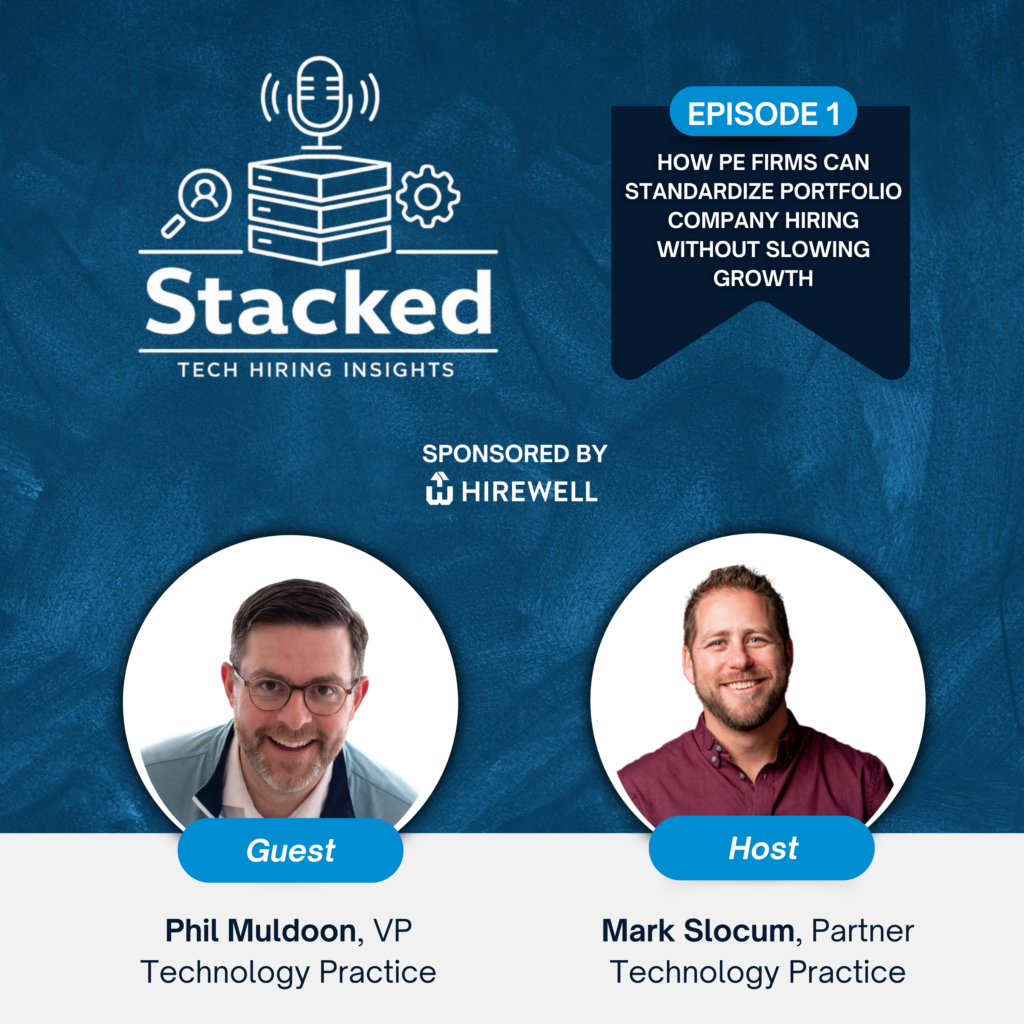
In this episode of Stacked, Mark sits down with Phil Muldoon to talk about how Hirewell is helping private equity firms and their...
Industrial hiring is a different animal. In this episode, Charlie Saffro, Jeff Smith, and Shannon DiBenedetto dig into what companies get wrong when...
Hiring demand is back. But the playbook changed. Companies still need talent. They just don’t want to overhire, lay people off, and do...
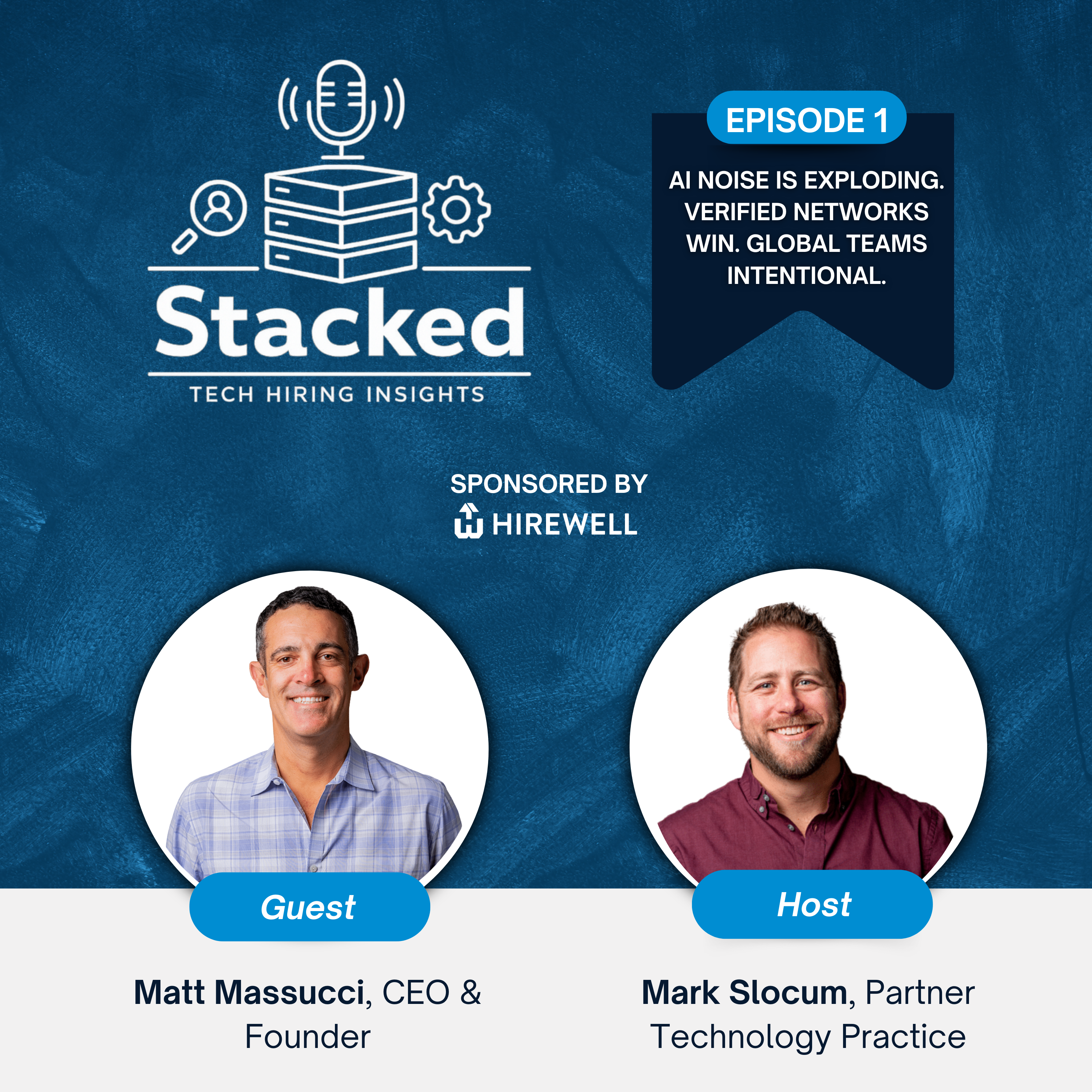
AI isn’t just changing how companies build. It’s changing who gets hired. We’re seeing a spike in fake candidates, AI-polished résumés, and hiring...
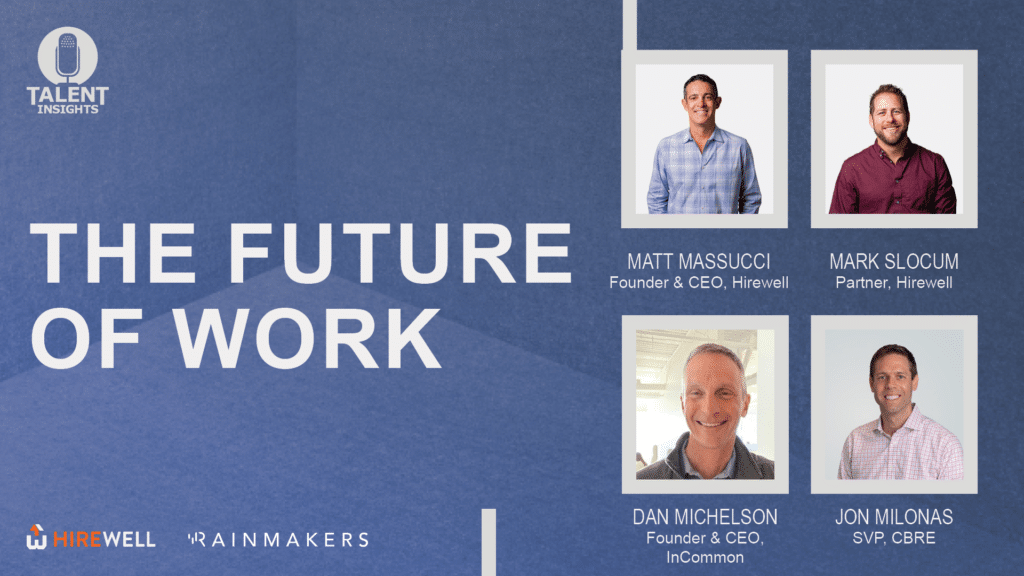
In this episode of Talent Insights, Hirewell CEO, Matt Massucci discusses “The Future of Work” with experts Jon Milonas, SVP at CBRE, Dan Michelson,...
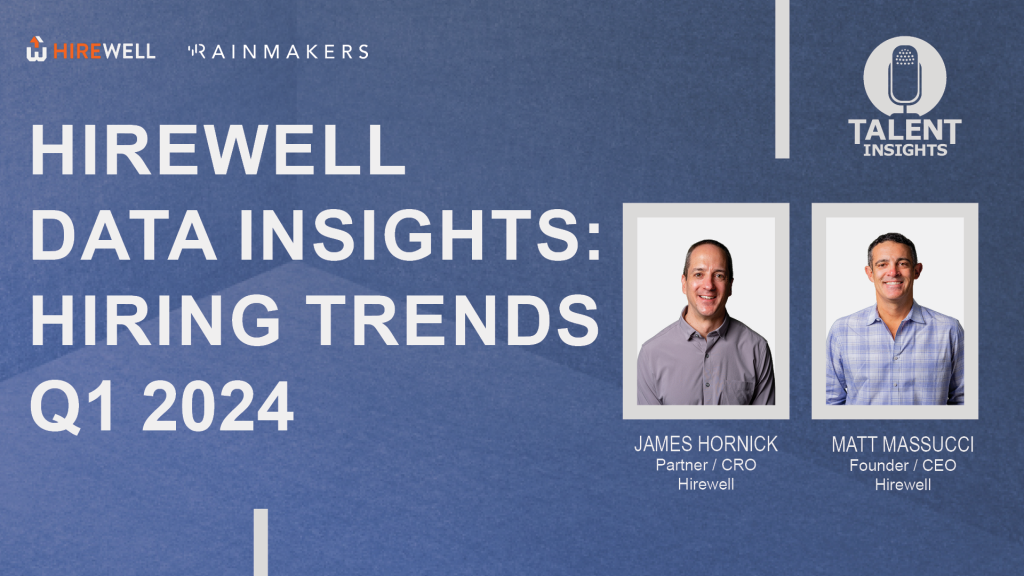
New year. New hiring market. Hopefully. 2023 was a year a lot of recruiters are happy to turn the page on. But it...
Our Shows













Our Latest Blog
No results found.
More from Our Blog
No results found.