I've hit a number of big milestones over the past few years (birthdays, anniversaries, etc.). Anyone who knows me ...
Q3 is in the books. For 6-8 weeks, we’ve talked about the increase in hiring activity. While it is too early to call it a complete comeback, the data is encouraging.
It is all about perspective. Let’s take a step back before talking about where we are today.
2023 was rough. From the peak of 2022 (May), we saw a steady 10-20% quarter-over-quarter decline. Each practice (Tech, GTM, Corporate Functions, Industrial, and Real Estate) saw slightly different trends. But none were very strong or consistent. Things bottomed out in the back half of 2023. That meant some pretty ugly numbers in Q3/Q4 of 2023.
Don’t believe me? Here is a not-so-fun chart.
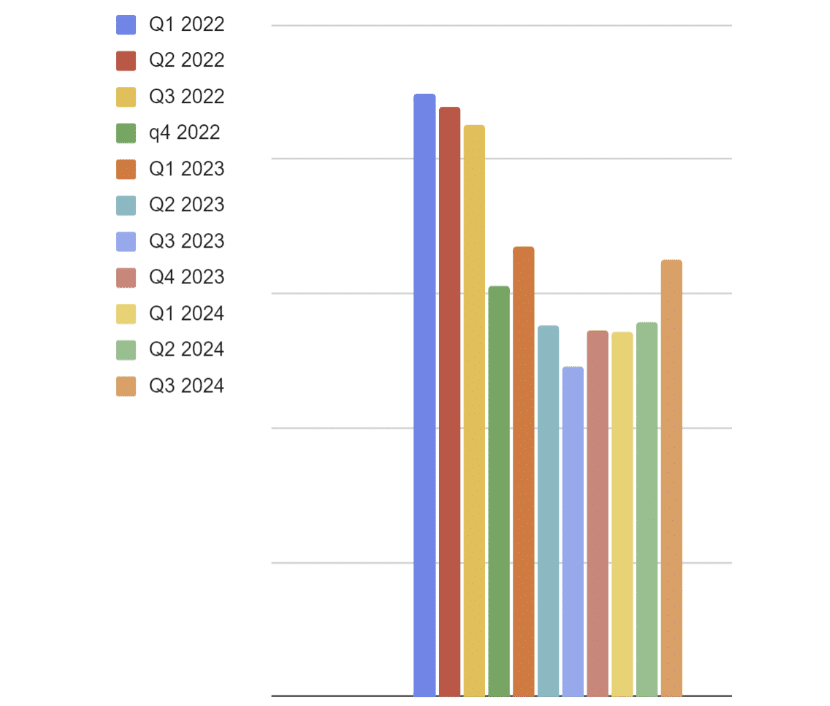
Those are the quarterly numbers for our tech practice (our largest team). In case you were wondering, yes, there was a bump in Q1 2023.
We’d signed a large project in Q4 2022 to do a multi-hire engagement (think 100+ roles). A large bank retained us to build their product and digital team. Unfortunately, they went out of business in March 2023 (halfway through the engagement). #RIPFirstRepublic.
For those of you counting at home, that’s a 50% peak-to-trough drop from Q1 2022 to Q3 2023. No bueno.
I’d love to say I handled all of this with the calm demeanor of a captain steering a ship through a storm. Not exactly. While it wasn’t Titanic-level bad, there were plenty of rough patches. Luckily, I’ve been surrounded by a great team to help navigate things.
One of our values is – Don’t stop, especially when things get tough.
Most people (myself included) roll their eyes when it comes to company values. But this one held true. Our team never stopped. It has shown in our recent results. Here are some trends.
A significant acceleration in Year-over-year hiring
- August starts were up 50% from 8/2023.
- Sept saw an even larger jump (95%) from Sept 2023.
- Those trends were across all practices, but the biggest year-over-year jump has been in tech (up 150% from Sept 2023)
- Overall we saw a 43% increase in Q3 2024, compared to Q3 2023
The largest Quarter-over-quarter improvement in 2+ years
- We saw a 25% jump in our Q3 numbers, compared to Q2 2024
- While numbers were strong across the board, our Go-To-Market practice saw the biggest spike (up 103%).
- Industrial hiring also saw big gains (up 54%)
Demand for RPOs and Multi-hire engagements
- If I had a chart for RPOs, it would have been uglier than the one I shared for tech. Those went away in 2023 (down 85% from 2022).
- In Q2, we launched 8 new engagements, after having kicking off 6 in all of 2023.
- All were extended in Q3 and our proposals have doubled in the past 3 months.
- Proposal size has also increased dramatically. We are seeing some big projects in the pipeline.
What does all of this mean for Q4? Your guess is as good as mine. We aren’t seeing any sign of things slowing down during the first two weeks of October. But October is typically a busy month for hiring.
I recently attempted to update our Q4 projections. I pulled our Q4 numbers for the past four years for a point of reference. In 2020 and 2021, Q4 was our largest quarter of the year (30% of our annual revenue). In 2022 and 2023, it was our smallest (20% of revenue).
What does it all mean?
Q4 can be great when the market is accelerating. And terrible when it is slowing down.
Insight like that is why I get paid the big bucks, I guess.
You know what would make me perfectly happy? Something in the middle…
What does that mean if you are looking to hire? There is still less competition than there was 2+ years ago. But most people don’t NEED to make a move (ie they won’t take your low ball offer).
Take advantage of it if you can. If these trends continue, it is going to get a lot more competitive in a quarter or two.
Happy hiring and check back in 3 months from now to see how things played out.
More blogs from Matt Massucci
Q1 is in the books. There is always a sense of uncertainty when the calendar flips. Every year, we make big plans ...
Over the last year, hiring teams have started seeing a wave of new job titles pop up across tech, sales, and ...
If you’re hiring in 2026, you’re dealing with two realities at the same time.
First, traditional signals like ...
Hiring in 2026 has a new problem.
It’s not a lack of applicants. It is too many of them. And differentiating ...
Plenty has been written about AI over the past two years. For much of that time, AI has been more hype than ...
Coming Soon...
See all Blog | Talent Insights Blog entries....
Our Latest Featured Episode

No results found.
Candidate Experience sucks right now. That’s it. That’s the show.
If you think back to 2021, when the job market was on fire, it was top of mind for everyone. Not just LinkedIn think pieces, but companies poured lots of time and effort into white-glove interview processes.
Now that the market cooled off, so did the effort. But there’s a disconnect: attracting talent isn’t any easier right now. In fact, it’s harder when you inadvertently cut corners.
Jeff Smith and James Hornick explain why ignoring candidate experience is costing companies big in The 10 Minute Talent Rant, Episode 111, “Candidate Experience Has Never Been Worse”
Episode 111
No results found.
Our Shows